Repo Hunter
A grimdark cyberpunk gun platformer. You repossess leased cyberware from cyborgs who stopped paying, then bolt it onto your own body.
Runs best in Chrome or Edge, on WebGPU with a WebGL2 fallback. The page also offers a native Linux build.
The game
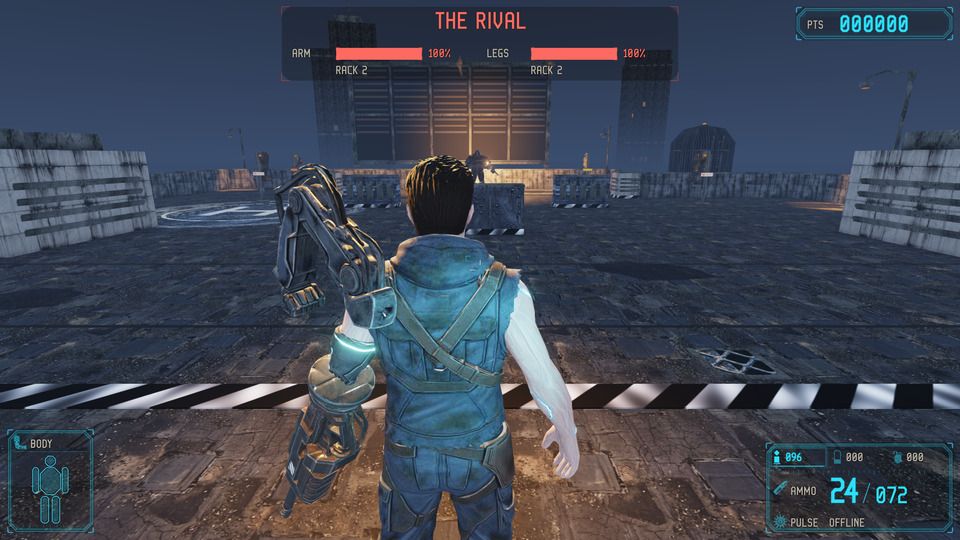
Three stages and a boss: the Clinic (rain-slick alleys up to the roofs), the Foundry (conveyor lines and vats) and the Spire (lifts, vent jets and shafts), then a rooftop duel with a rival hunter who swaps parts mid-fight. Down a cyborg, hold Interact on a limb, and wear it.
- Your loadout is your moveset. Arms are guns: a rifle, a scatter arm with heavy knockback, a grenade launcher. Spring legs jump higher; anchor legs shrug off stomps. Loadout mass sets your acceleration, air control and jump height.
- Mag-grip and pulse. Pull bodies, parts and crates to you and throw them, or shove everything away with a shockwave, including grenades already in the air.
- Hard. Enemies flank and throw grenades, mechs mortar and kick, and checkpoints keep retries short. Keyboard and mouse, or a gamepad.
How it's built
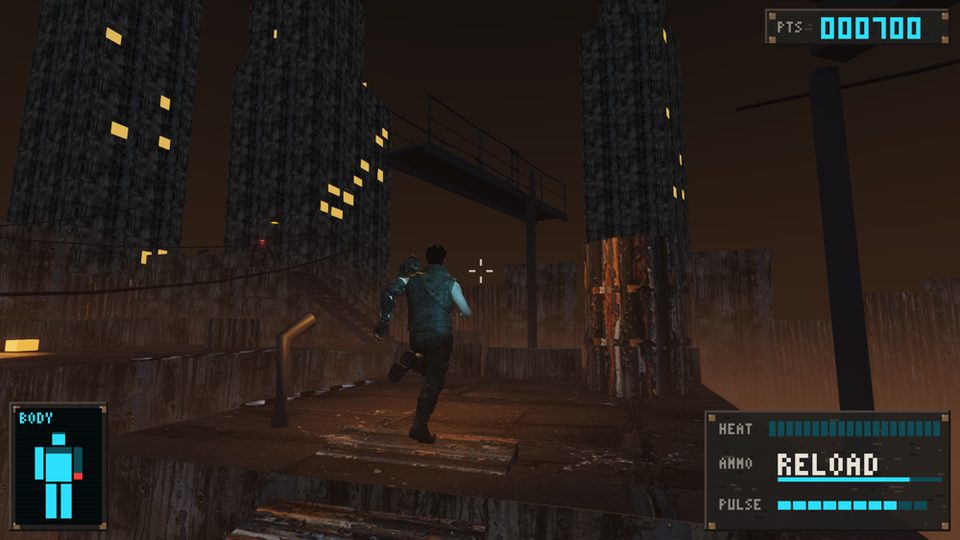
- On my own engine. C++ on crucible, fetched unmodified at a pinned commit. Physics, skinned models, particles, audio and the browser page are the engine's; the game is one module per system on top.
- Ripping is real physics. Downed enemies become Jolt ragdolls built from a 24-joint rig, and a rip removes that bone from the ragdoll and throws the part as its own rigid body. Grenades are physics bodies too, which is why the pulse can bat them back.
- One codebase, native and web. The same build targets Linux and, through Emscripten, the browser. The page tries WebGPU on the fast GPU, then the low-power one, then falls back to WebGL2, and a first-frame watchdog switches to WebGL2 if WebGPU stalls.
- Holds frame rate by itself in the browser. The engine picks a quality tier for the GPU it finds, then moves the render scale toward 16.7 ms frames. On software rendering it drops to a CPU tier: a smaller canvas, vertex lighting, merged static geometry and a shorter draw distance.
- Tuned by bots. Every gameplay number lives in one file. A headless bot with human-like reaction time and aim noise plays 20 seeds per change, and difficulty passes are kept only when clear rate, deaths per section and stuck time all hit their targets. Six iterations took the bot from 0 deaths a run to about 1.5.
- Generated assets, with receipts. Textures, models, music and sound come from generative tools, picked in listening and viewing rounds and locked to written style specs. A ledger records each file's tool, prompt, hash and licence. An AI critic scores the visuals and sounds, and the final picks are made by hand.